
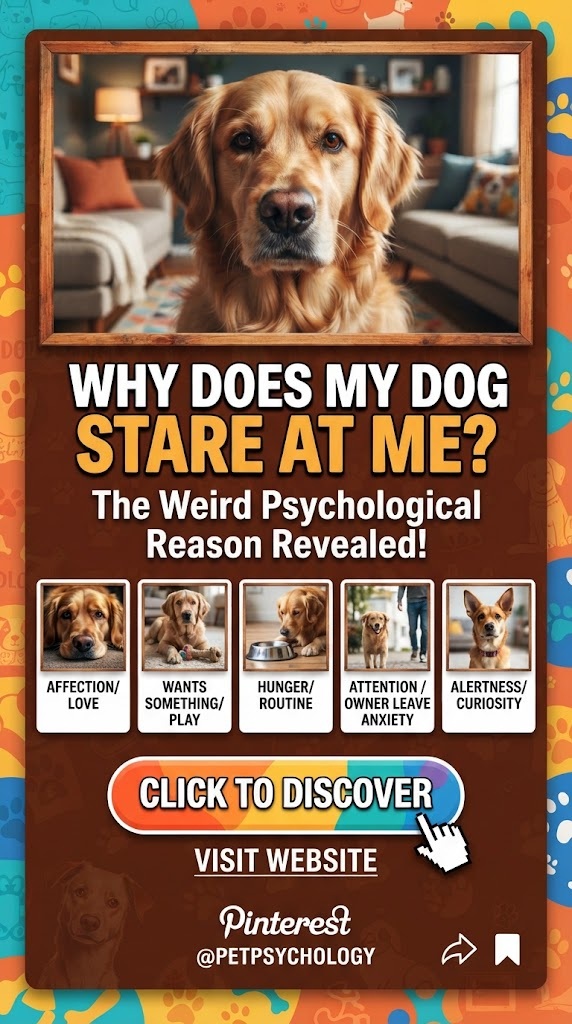

Why Does My Dog Stare at Me? The Weird Psychological Reason Revealed
You’re sitting on the couch, minding your own business, perhaps scrolling through your phone or watching a movie, when you feel it—that prickling sensation on the side of your neck. You turn your head slowly, and there they are. Your dog is sitting perfectly still, eyes locked onto yours with an intensity that would make a world-class poker player blink.
They aren’t barking. They aren’t wagging their tail. They are just… staring.
It’s one of the most common, yet deeply mysterious, behaviors in the canine world. As dog owners, we often joke that they’re “judging” us or “using mind control” to get a treat. But the truth is far more fascinating. There is a profound, almost eerie psychological reason why your dog stares at you, and it involves a biological “hack” that dogs evolved over thousands of years to hijack the human brain.
In this comprehensive guide, we will dive deep into the science of the canine gaze, the “love loop” of oxytocin, and the evolutionary secrets that explain why your furry best friend can’t take their eyes off you.
1. The “Love Loop”: The Weird Psychological Reason
If you’ve ever felt a deep, soulful connection while looking into your dog’s eyes, you aren’t imagining it. There is a specific psychological and biological phenomenon occurring called the Oxytocin Feedback Loop.
The Science of the “Gaze”
In 2015, a landmark study published in the journal Science revealed something incredible. Researchers in Japan found that when dogs and humans stare into each other’s eyes, both species experience a massive spike in oxytocin.
Oxytocin is often called the “love hormone” or the “cuddle chemical.” It is the same hormone that facilitates the bonding process between a human mother and her newborn baby. When a mother looks at her infant, oxytocin levels rise, creating a sense of intense well-being and a drive to protect and nurture.
Interspecies Hijacking
This is the “weird” part: Dogs are the only non-human species known to have successfully “hijacked” this human bonding pathway.
While wolves (the ancestors of dogs) view prolonged eye contact as a threat or a challenge, domestic dogs have evolved to use it as a tool for social bonding. Through thousands of years of domestication, dogs that could lock eyes with humans and trigger that oxytocin release were more likely to be fed, sheltered, and kept safe.
The result? Your dog stares at you because, on a biological level, they are reinforcing a chemical bond that mirrors the parent-child relationship. They are literally “loving” you with their eyes.
2. Reading the Room: Social Cognition and “Theory of Mind”
Beyond the chemical bond, dogs stare because they are world-class detectives. They are trying to gather information about your next move. This is known in psychology as Social Cognition.
Do Dogs Have a “Theory of Mind”?
In human psychology, “Theory of Mind” is the ability to understand that others have beliefs, desires, and intentions different from our own. While scientists debate whether dogs possess a full “Theory of Mind,” they certainly possess a highly developed version of it regarding humans.
Your dog stares at you to “read” your facial expressions and body language. They are looking for cues:
- The Reach: Are you moving toward the leash?
- The Look: Are you glancing toward the kitchen (where the treats are)?
- The Mood: Are you stressed? Dogs can detect subtle changes in our facial muscles that indicate sadness, anger, or joy.
They stare because they are waiting for the “starting gun” of an activity. To a dog, you are the bringer of all good things—food, walks, and affection. Staring is their way of ensuring they don’t miss a single second of the action.
3. The “Lassie” Effect: Communication and Requests
Sometimes, the stare isn’t about love or detective work; it’s a functional form of communication. Since dogs cannot speak, they use their eyes as a pointing device.
The Referential Gaze
Behaviorists call this the “referential gaze.” If your dog stares at you, then glances at the door, then stares back at you, they are using a sophisticated form of communication to tell you what they want.
Common “requests” hidden behind a stare include:
- The “I Need to Go” Stare: Usually accompanied by pacing or standing near the door.
- The “Empty Bowl” Stare: A fixed, unblinking gaze that usually happens around 5:00 PM (dinner time).
- The “Lost Toy” Stare: If a ball rolls under the couch, your dog will stare at you and then at the couch, essentially saying, “Hey, human, use your long arms to help me out.”
4. Understanding “The Eye”: Genetic Predispositions
Not all stares are created equal. Depending on your dog’s breed, the stare might be hard-wired into their DNA for functional purposes.
Herding Breeds and “The Eye”
If you own a Border Collie, Australian Shepherd, or Corgi, you’ve likely seen “The Eye.” This is a low-crouched, intense, unblinking stare used to control livestock.
In a domestic setting, these dogs may “herd” you. If you are moving around the kitchen and your Border Collie is staring at your ankles with predatory intensity, they aren’t necessarily looking for love—they are instinctively trying to “direct” your movement.
Brachycephalic Breeds
Dogs with flat faces and large eyes (like Pugs, French Bulldogs, and Boston Terriers) often appear to be staring more than other breeds. This is partly due to their facial structure—their eyes are more prominent—but also because these breeds were specifically bred to be companions. Their entire “job” for centuries has been to look at and interact with their owners.
5. The “Wait and See” Strategy: Operant Conditioning
Let’s be honest: your dog stares at you because it works.
This falls under the psychological principle of Operant Conditioning. If your dog stares at you while you’re eating a sandwich, and you eventually give them a crust because you feel “guilty” or “watched,” you have just reinforced the behavior.
Dogs are masters of persistence. They understand that a stare is a low-energy, high-reward tactic. If staring at you leads to a pat on the head or a piece of cheese even 10% of the time, they will continue to do it. This is known as an intermittent reinforcement schedule, which is the same psychological mechanism that makes slot machines so addictive.
6. Reading the “Soft” vs. “Hard” Stare
While most staring is harmless or affectionate, it is crucial for every dog owner to understand the difference between a “soft” stare and a “hard” stare. Canine body language is subtle, and misinterpreting a stare can lead to dangerous situations.
The Soft Stare (Affectionate)
- Eyes: Relaxed, squinty, or “dreamy.”
- Face: Relaxed mouth (often slightly open), ears in a neutral position.
- Body: Wiggling or relaxed posture.
- Meaning: “I love you,” or “I’m comfortable with you.”
The Hard Stare (Aggressive/Threatening)
- Eyes: Wide, unblinking, often showing the whites of the eyes (known as “Whale Eye”).
- Face: Tense muzzle, ears pinned forward or tightly back, closed mouth.
- Body: Rigid, frozen, or leaning forward.
- Meaning: “Stop what you are doing,” or “I am guarding this resource.”
Safety Tip: If a dog you don’t know is staring at you with a stiff body, do not maintain eye contact. In the dog world, a direct, hard stare is a challenge. Looking away is a “calming signal” that tells the dog you are not a threat.
7. Emotional Intelligence: Can They Sense Our Mood?
Have you ever noticed that your dog stares at you more intently when you’re crying or when you’re angry?
Dogs are incredibly sensitive to cortisol (the stress hormone). Research has shown that dogs can smell the chemical changes in our sweat and breath when we are stressed or afraid. When they sense these changes, they stare to gather more “data.”
They are trying to figure out:
- Is there a threat?
- Do I need to comfort my human?
- Is the “pack leader” unstable right now?
This “empathic staring” is one of the reasons dogs are such effective emotional support animals. They are literally monitoring your physiological state through sight and smell.
8. Why Senior Dogs Stare: Cognitive Dysfunction
If you have an older dog who has suddenly started staring at you—or staring at walls, corners, or “nothing”—the reason might be medical rather than psychological.
Canine Cognitive Dysfunction (CCD) is similar to Alzheimer’s in humans. As a dog’s brain ages, they can become disoriented. A senior dog may stare at you because they have “lost their place” in a task or because they are looking for reassurance in a world that has become confusing.
If the staring is accompanied by:
- Wandering at night
- Getting stuck in corners
- Forgetting house training
- Failing to recognize familiar faces
…it is time to consult a veterinarian. There are medications and supplements that can help manage these symptoms.
9. Staring While They Poop: The Ultimate Vulnerability
One of the most awkward moments for any dog owner is when your dog locks eyes with you while they are “doing their business” in the yard. Why can’t they just look at the grass?
The reason is rooted in survival. In the wild, a dog is at its most vulnerable when it is eliminating. They cannot run or fight effectively in that position. By staring at you, they are looking to you for a safety signal.
Essentially, they are saying: “I’m busy right now and can’t look out for predators. You’re watching my back, right?” If you look away suddenly or startle, your dog might cut their business short because they think you’ve spotted danger.
10. How to Respond to the Stare
Should you stare back? Should you ignore it? How you respond depends on the context.
If it’s for Love
If your dog is giving you “puppy dog eyes” (a soft stare), feel free to look back, talk softly to them, and give them a pat. This strengthens your bond and releases that hit of oxytocin for both of you.
If it’s for Begging
If the stare is a “sandwich stare,” the best response is to ignore it. Looking at the dog, even to say “no,” is a form of attention. If you want the behavior to stop, you must wait until they look away, then reward that “calm” behavior.
If it’s for Direction
If your dog is staring because they need something (like a walk), acknowledge the communication. Ask them, “What do you want?” or “Outside?” If they react excitedly, they’ve successfully communicated their need.
11. Frequently Asked Questions (FAQ)
Q: Why does my dog stare at me while I’m sleeping?
A: Your dog is likely monitoring you. Since you are the “alpha” or the provider in their life, they want to be the first to know when you wake up. They are also comforted by your rhythmic breathing.
Q: Is it true that dogs can see “ghosts” when they stare at nothing?
A: While it’s a fun spooky theory, the reality is that dogs have much better hearing and smell than we do. If your dog is staring at a “blank” wall, they might be hearing a mouse in the drywall or smelling a neighbor’s cooking through a vent.
Q: Why does my dog stare at me from another room?
A: This is often a sign of “shadowing.” Some dogs, particularly those with separation anxiety, feel the need to keep their owners in their line of sight at all times to feel secure.
Q: Does my dog stare at me because they’re dominant?
A: In a stable household, staring is rarely about dominance. It is almost always about affection, communication, or information gathering. Dominance-based staring is usually accompanied by aggressive body language (growling, stiff tail).
12. Conclusion: The Power of the Gaze
The next time you find your dog staring at you, take a moment to appreciate the complexity of that gaze. It isn’t just “weird” dog behavior; it is the result of 30,000 years of co-evolution.
Whether they are hacking your brain for an oxytocin boost, trying to tell you that their ball is under the fridge, or simply watching their favorite person in the world, the stare is a testament to the unique bond between humans and dogs.
Your dog stares because you are their world. They are studying you, loving you, and waiting for you. And honestly? We’re probably staring right back at them just as much.
Summary Checklist: Why is your dog staring?
- Oxytocin: They are bonding with you.
- Information: They are waiting for a cue or a treat.
- Communication: They need to go outside or want a toy.
- Instinct: They are a herding breed practicing “The Eye.”
- Vulnerability: They are checking that you’re guarding them (common during potty breaks).
- Health: In senior dogs, it could be a sign of confusion.
Final Thought: If the stare is soft and accompanied by a wagging tail, lean into it. It’s one of the few ways your dog can say, “I’m glad you’re mine.”