
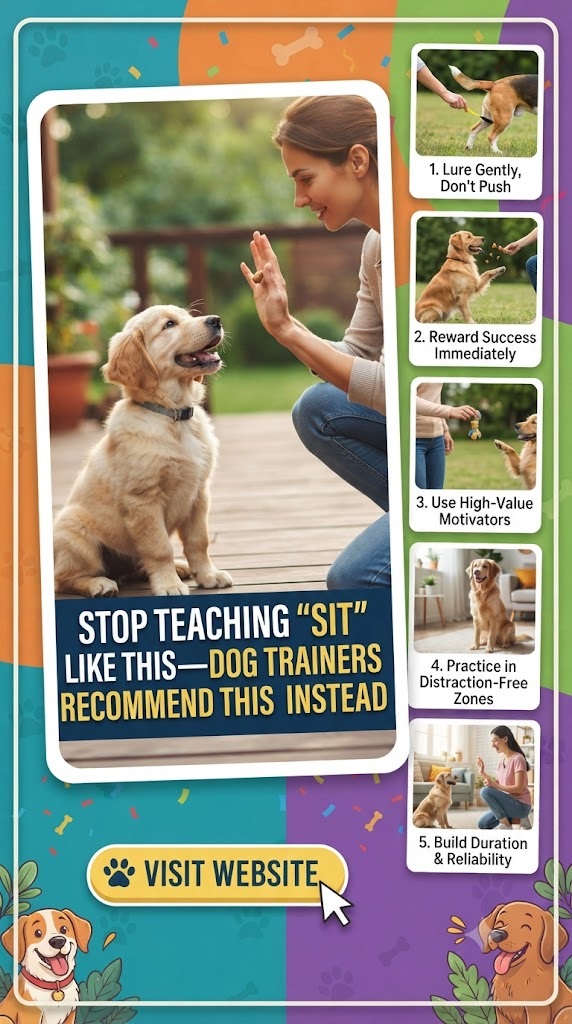

The “Sit” Command Is Wrong – Do THIS Instead for Instant Obedience
For decades, the “Sit” command has been the holy grail of dog training. It is the first thing we teach a puppy, the first thing a shelter volunteer asks of a rescue, and the default response for almost every owner when their dog starts acting up. But here is the uncomfortable truth that professional behaviorists and high-end trainers have known for years: The “Sit” command is one of the most ineffective tools in your training arsenal for achieving true, long-term obedience.
If you have ever been in a situation where your dog is lunging at a squirrel, barking at the doorbell, or jumping on a guest, and you frantically scream “SIT!” only to be completely ignored, you already know this. The “Sit” command is a physical posture, but it does nothing to address the dog’s internal state of mind.
To get instant, reliable obedience in high-stress situations, you need to stop focusing on what your dog’s rear end is doing and start focusing on their brain. This guide will show you exactly why “Sit” is failing you and the revolutionary “State of Mind” method you should use instead.
The Fatal Flaw of the “Sit” Command
Why is “Sit” the default? Because it’s easy for humans to visualize. We see a dog sitting and we think, “Good, they are being still.” However, there is a massive difference between a dog that is sitting because it is calm and a dog that is sitting while its brain is vibrating with over-arousal.
1. The “Vibrating” Sit
Have you ever seen a dog sit, but their entire body is trembling, their eyes are dilated, and they are ready to bolt the second you blink? This is a “vibrating sit.” While the dog is technically obeying the physical command, their adrenaline is spiking. They aren’t learning self-control; they are simply loading a spring. The moment the release word comes—or their leash tension breaks—they explode.
2. It’s a Passive Command
“Sit” is a static command that doesn’t require the dog to check in with the owner. A dog can sit while staring intently at a trigger (like another dog). By allowing the dog to obsessively fixate on something else while sitting, you are actually reinforcing their reactive behavior.
3. Physical Discomfort
For many dogs—especially older dogs with hip dysplasia, deep-chested breeds, or sighthounds—the physical act of sitting can be uncomfortable or even painful. When a dog associates a command with physical discomfort, they will eventually build a negative association with your training altogether.
The Solution: “The Place” Command and “Capturing Calm”
If you want instant obedience, you must stop asking for a posture and start asking for a State of Mind. Instead of “Sit,” the most powerful tool in modern dog training is the “Place” command combined with “Relaxation Protocol.”
The “Place” command tells a dog to go to a specific boundary (a bed, a cot, or a rug) and stay there until released, regardless of what is happening around them. Unlike “Sit,” which is often a temporary 3-second behavior, “Place” is a long-duration command that teaches the dog to deactivate their nervous system.
Why “Place” Beats “Sit” Every Time:
- Defined Boundaries: A dog understands a physical boundary (the edge of a bed) better than an abstract “stay” in open space.
- Mental Decompression: “Place” encourages the dog to lie down and eventually shift their weight, which triggers a parasympathetic nervous system response (the “rest and digest” mode).
- Duration is Built-in: You don’t have to keep repeating the command. Once the dog is on their “Place,” they remain there until told otherwise.
Step-by-Step: How to Teach “Place” for Instant Obedience
To transition from the “Sit” trap to “Place” mastery, follow these steps. You will need a raised dog cot or a very specific rug that feels different from your normal flooring.
Step 1: The Lure and Reward
Hold a high-value treat (chicken, freeze-dried liver, or cheese) to your dog’s nose. Lead them onto the designated “Place” mat. The moment all four paws are on the mat, say “Place” and give them the treat. Do not ask for a sit or a down yet. Just reward them for being on the boundary.
Step 2: The “Deactivation” Drop
Once your dog is comfortable stepping onto the mat, wait them out. Do not give a command. Eventually, the dog will get bored and lie down. The moment their elbows touch the mat, mark it with a “Yes!” and a jackpot of treats. This is the “State of Mind” shift. You are rewarding them for choosing to relax, not for following a robotic instruction.
Step 3: Adding the “Three Ds” (Distance, Distraction, Duration)
This is where the “Instant Obedience” happens. While the dog is on their place, start introducing mild distractions.
- Distance: Take two steps back. If they stay, return and reward.
- Distraction: Bounce a ball nearby or open the front door. If they stay on the mat, they get a high-value reward.
- Duration: Increase the time they spend on the mat from 1 minute to 30 minutes.
Step 4: The Release Word
A command is only a command if it has a clear end. Use a word like “Break” or “Free” to tell the dog they can leave the mat. Never let them just wander off. This creates the “contract” of obedience: I stay here until you tell me the job is done.
Beyond the Mat: The “Middle” Command for High-Stress Environments
If you are out on a walk and “Sit” isn’t working, don’t keep repeating it. Instead, use the “Middle” command.
“Middle” is when your dog comes and stands between your legs, facing forward. This is a “Tactical Reset” that provides several psychological benefits:
- Physical Security: The dog feels your legs on either side, which acts like a “thundershirt” effect, calming their anxiety.
- Visual Blocking: You are physically blocking the dog’s view of the trigger (the other dog or the scary trash can).
- Owner Connection: It forces the dog to move toward you rather than away from you toward the distraction.
How to Train “Middle”:
- Stand with your legs wide.
- Lure your dog behind you and through your legs with a treat.
- As they come through and stand between your legs, say “Middle.”
- Feed them multiple treats in this position to build “value” for being close to you.
When your dog is in “Middle,” they aren’t just sitting; they are engaging in a “working” position that requires focus and provides safety.
The Secret Ingredient: Impulse Control Games
The reason “Sit” fails is that most dogs have zero impulse control. They are slaves to their whims. To get instant obedience, you must treat your dog’s brain like a muscle that needs to be flexed. Stop using “Sit” as a way to control them, and start using Impulse Control Games to teach them to control themselves.
The “Leash Pressure” Game
Most owners pull back on the leash when a dog lunges, which triggers the “opposition reflex” (the dog pulls harder). Instead, teach your dog that yielding to pressure earns a reward.
- In your living room, apply a tiny bit of upward pressure on the leash.
- The moment the dog looks at you or moves toward the pressure, release it and reward.
- This teaches the dog that when the world gets tense, the answer is to “check in” with the handler, not to “sit” and stare at the problem.
The “Wait for the Bowl” Reset
Stop putting the food bowl down while your dog is dancing and spinning. This creates a “frantic” state of mind that carries over to the rest of their life.
- Hold the bowl up.
- Wait for eye contact (not a sit!).
- Lower the bowl. If the dog moves, lift the bowl back up.
- The dog only gets to eat when they are standing or sitting in a calm state.
Why “Eye Contact” is More Important Than Any Command
If you can’t get your dog to look at you, you don’t have control. A dog that is sitting but staring at a cat is 90% of the way toward a blowout.
Instead of shouting “Sit!”, work on The Name Game. Your dog’s name should mean one thing: “Look at my eyes for further instructions.”
Training the “Automatic Check-In”:
Whenever you are on a walk and your dog naturally looks back at you, mark it with “Yes!” and reward. Do this hundreds of times. Eventually, when your dog sees something scary or exciting, their first instinct won’t be to bark or sit—it will be to look at you and ask, “What’s the plan?” This is the definition of instant obedience.
The “Biological Fulfillment” Factor
Sometimes, the “Sit” command fails because the dog’s biological needs aren’t being met. You cannot ask a dog to “Sit” and be calm if they have a “full tank” of pent-up energy and predatory drive.
Before you expect instant obedience, ensure you are providing:
- Decompression Walks: Walks on a long line (15-20 feet) where the dog is allowed to sniff and “be a dog.” Sniffing lowers a dog’s heart rate.
- Appropriate Outlets: If you have a Herding breed, give them a Flirt Pole. If you have a Terrier, give them something to dig or shred.
- Mental Stimulation: 15 minutes of scent work or a puzzle toy is more exhausting for a dog than a hour-long run.
A “fulfilled” dog is a dog that is physically capable of obeying. An unfulfilled dog is a “loaded gun” of energy that no “Sit” command can hold back.
Real-World Scenarios: Putting it Into Practice
Let’s look at how replacing “Sit” with “State of Mind” training works in the real world.
Scenario A: Someone Knocks at the Door
- Old Way: You scream “SIT! SIT! SIT!” while the dog barks, jumps on the door, and eventually sits for half a second before jumping on the guest.
- New Way: You give the “Place” command. The dog goes to their raised cot. Because they know the “Place” contract, they stay there. They watch the guest enter from a distance. Because they are lying down, their heart rate stays low. You only release them when they are calm and the guest is settled.
Scenario B: Passing Another Dog on a Leash
- Old Way: You pull the leash short and tell the dog to “Sit” as the other dog passes. Your dog fixates, grows, and eventually lunges as the other dog gets close.
- New Way: You see the other dog. You step off the path and ask for “Middle” or “Focus.” You reward your dog for looking at you. You keep moving. If the dog gets too excited, you use a “Touch” command (booping their nose to your hand) to redirect their physical energy into a movement-based task.
Summary: The New Rules of Engagement
To get the instant obedience you’ve always wanted, follow these golden rules:
- Stop Overusing “Sit”: Use it only when you need a quick transition, not as a solution for bad behavior.
- Prioritize “Place”: Make the “Place” command your dog’s favorite “job.” It’s the ultimate tool for calmness.
- Reward the “Unasked-for” Calm: When you see your dog lying down quietly while you’re cooking or watching TV, drop a treat between their paws. Reward the state of mind you want to see more of.
- Focus on Engagement, Not Posture: A dog looking at you is a dog that is listening. A dog sitting and looking away is a dog that is ignoring you.
- Control the Environment, Not Just the Dog: Don’t put your dog in a position to fail. Use distance and high-value rewards to build success.
The “Sit” command isn’t “wrong” in a vacuum, but it is the most misunderstood and poorly applied tool in the dog owner’s kit. By switching your focus to State of Mind, Boundaries, and Engagement, you will stop managing your dog’s movements and start influencing their brain. That is the secret to the instant, effortless obedience that every dog owner dreams of.