
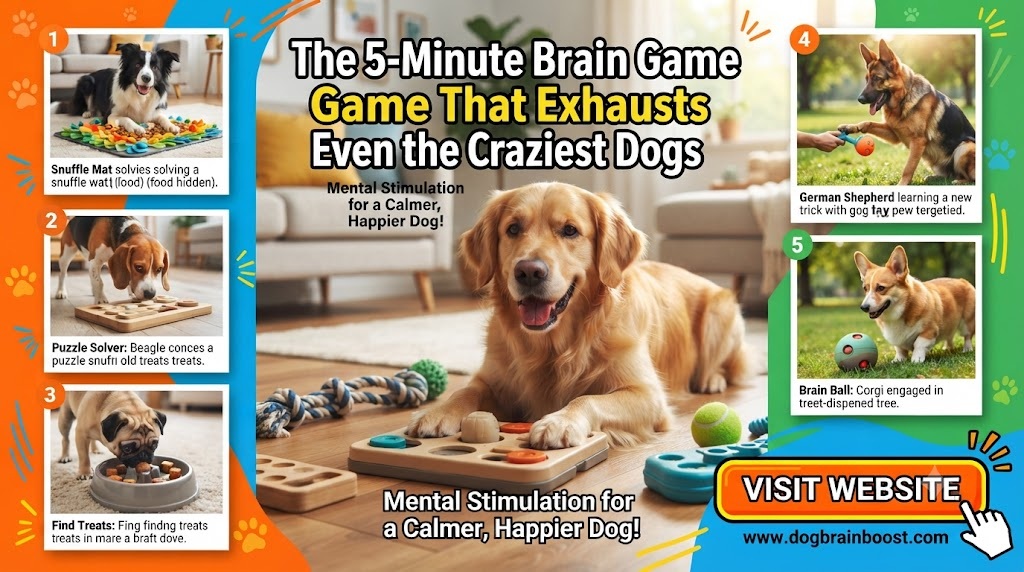

The 5-Minute Brain Game That Tires Out Any High-Energy Dog
Every dog owner knows the feeling. You’ve just returned from a two-hour hike, your legs are heavy, and you’re ready to collapse on the couch. You look down, expecting to see your furry companion drifting off into a peaceful slumber. Instead, your dog is staring at you with wide, frantic eyes, a tennis ball dropped squarely on your lap, ready for round two.
For owners of high-energy breeds—be it a Border Collie, a Belgian Malinois, a Labrador, or a Jack Russell Terrier—physical exercise often feels like a losing battle. You are essentially building an elite athlete. The more you walk them, the fitter they get, and the more exercise they require to reach that elusive state of “tired.”
But what if the secret to a calm, sleepy dog wasn’t more miles on the pavement, but a five-minute challenge for their brain?
The truth is, mental stimulation is significantly more exhausting for dogs than physical exertion. In fact, experts often suggest that 15 minutes of intense mental work is equivalent to an hour of running. This article reveals the ultimate 5-minute brain game that will transform your hyperactive pup into a relaxed companion, along with the science of why it works and several other high-impact games to add to your toolkit.
Why Physical Exercise Isn’t Enough
Before we dive into the “Magic Game,” we must understand the “Stamina Trap.” When we rely solely on physical exercise to tire out a dog, we are training their cardiovascular system. A dog that runs five miles every day will soon need seven miles to feel the same level of fatigue. You are essentially creating a marathon runner with a never-ending gas tank.
Furthermore, physical exercise often spikes a dog’s cortisol and adrenaline levels. While they may be physically tired, their brain is “wired.” This leads to a dog that can’t settle, becomes over-reactive to noises, or develops “zoomies” in the evening.
Mental stimulation, on the other hand, engages the dog’s cognitive functions, requiring focus, problem-solving, and sensory processing. This drains their energy from the inside out, leading to a profound sense of satisfaction and a natural “calm” that physical play rarely achieves.
The Ultimate 5-Minute Game: “Scent Scavenger Hunt”
If you could only play one game with your dog for the rest of their life, it should be the Scent Scavenger Hunt. This game leverages a dog’s most powerful sense—their nose—to provide an intense cognitive workout.
Why It Works
A dog’s sense of smell is between 10,000 and 100,000 times more acute than ours. A massive portion of their brain is dedicated to processing scents. When a dog “works” their nose, they are essentially running a supercomputer at full capacity. This lowers their heart rate, reduces stress, and burns through mental energy at a staggering rate.
How to Play (Step-by-Step)
Level 1: The “Easy Find”
- Prepare the Treats: Take five to ten pieces of high-value, smelly treats (dehydrated liver, cheese, or small bits of chicken).
- The Stay: Put your dog in a “sit” or “stay” position. If they don’t have a reliable stay, have someone hold them or put them in another room.
- The Placement: While the dog is watching, place the treats on the floor in obvious spots within a small area (like a living room rug).
- The Release: Give the command “Find it!” and point to the treats.
- The Reward: Let them eat the treats. Repeat this three times until they associate the command “Find it” with looking for food.
Level 2: The “Hidden Treasure”
- Out of Sight: Now, put your dog in another room where they cannot see you.
- Strategic Hiding: Hide the treats in slightly more difficult places: under the edge of a rug, on the bottom rung of a chair, or behind a door. Keep them at nose level for now.
- The Search: Release the dog with the “Find it!” command. Do not help them. Let them use their nose to navigate the room.
- The Victory: When they find the last one, give them a “jackpot” (an extra treat from your hand) and lots of praise.
Level 3: The “Vertical and Deep” (The 5-Minute Burner)
This is where the real exhaustion happens.
- Multi-Room Challenge: Hide treats across two or three rooms.
- Verticality: Hide treats on different heights (on a low coffee table, tucked into a sofa cushion, or on a windowsill).
- The “Scent Tunnel”: Hide a treat inside an empty cardboard box or under an upturned plastic cup.
- The Hunt: Let them go. You will see their nose twitching rapidly. This “sniffing” action actually requires significant physical effort from their respiratory system and total mental focus.
Why this tires them out in 5 minutes: The dog has to remember where they have already looked, differentiate between “old” scent and “fresh” scent, and solve the physical problem of how to reach the treat. By the time they find the 10th treat, most dogs will immediately go to their bed to process the “hunt.”
The Science of the “Sniff”
To understand why this 5-minute game is so effective, we have to look at canine physiology.
The Olfactory Bulb
In humans, the olfactory bulb (the part of the brain that processes smell) is about the size of a postage stamp. In dogs, it is 40 times larger. When a dog engages in scent work, they are stimulating the prefrontal cortex. This is the same part of the brain humans use for complex math or learning a new language.
Lowering Cortisol
Studies have shown that “nose work” increases the release of dopamine (the feel-good hormone) while simultaneously lowering cortisol (the stress hormone). High-energy dogs are often in a state of high arousal. Scent work forces them to slow down, take deep breaths through their nose, and focus. It is essentially “dog yoga.”
The Jacobson’s Organ
Dogs also have a special organ called the vomeronasal organ (or Jacobson’s organ) located in the roof of their mouth. This organ allows them to “taste” scents. Using this organ requires a specific type of flicking motion with the tongue and a concentrated breath, which is physically tiring for the facial muscles and the diaphragm.
3 Other 5-Minute Brain Games for Variety
While the Scavenger Hunt is the gold standard, variety prevents boredom. Here are three other high-impact games to rotate into your routine.
1. The “Muffin Tin Mania”
This is a fantastic “Pantry Puzzle” that requires zero special equipment.
- What you need: A standard muffin tin, 12 tennis balls, and some treats.
- The Setup: Place treats in a few of the muffin cups. Cover all 12 cups with tennis balls.
- The Goal: The dog must smell which cups have treats and figure out how to remove the tennis balls to get to the reward.
- The Challenge: Some dogs will use their paws, others their snout. The process of trial and error is what drains their energy.
2. The “Towel Roll-Up”
This is a surprisingly difficult game for many dogs.
- What you need: An old bath towel and a handful of kibble.
- The Setup: Lay the towel flat. Scatter treats across it. Roll the towel up into a long “snake” or “log” shape.
- The Goal: The dog must use their nose and paws to unroll the towel inch by inch to reveal the treats.
- The Level-Up: Once they master the roll, tie the towel into a loose knot. The mental energy required to “untie” the knot is immense.
3. The “Shell Game” (Object Discrimination)
This game builds focus and “listening” skills.
- What you need: Three identical opaque plastic cups.
- The Setup: Place a treat under one cup while the dog watches. Shuffle the cups slowly.
- The Goal: The dog must point to, paw, or nudge the correct cup.
- The Benefit: This isn’t just about scent; it’s about visual tracking and patience. It forces the dog to work against their impulse to just knock all the cups over.
How to Integrate Brain Games into a Busy Schedule
The beauty of these games is that they don’t require a trip to the park or a change of clothes. You can do them in your pajamas while your coffee is brewing.
The “Morning Brain-Drain”
Instead of putting your dog’s breakfast in a bowl—where they likely inhale it in 30 seconds—use that food for a scavenger hunt. Scatter their kibble in the grass in the backyard or hide it around the kitchen. They will start their day with a focused task, making them much more likely to sleep while you are working.
The “Post-Work Decompression”
When you get home from work, your dog is likely vibrating with pent-up energy. Before you take them for a walk, do 5 minutes of the “Towel Roll-Up.” This “lowers the temperature” of their excitement. They will then be more focused and less likely to pull on the leash during their actual walk.
The “Rainy Day Savior”
When the weather is terrible and a long walk isn’t an option, three 5-minute sessions of brain games spread throughout the day will result in a more tired dog than a miserable, wet 20-minute walk.
Common Mistakes to Avoid
To ensure these games remain effective and don’t cause frustration, avoid these common pitfalls:
- Making it Too Hard, Too Fast: If your dog can’t find the treat, they will get frustrated and give up (or start barking at you). Start with “easy wins” to build their confidence.
- Using Low-Value Rewards: If you’re using plain dry kibble and your dog isn’t particularly food-motivated, they might not see the point. Use something “stinky” like salmon skin or freeze-dried beef to get their olfactory system firing.
- Over-Helping: It’s tempting to point to the treat the moment your dog looks confused. Resist! The “work” is in the confusion. As long as they are still trying, let them think.
- Neglecting Water: Sniffing is thirsty work! Rapid breathing and scent processing dry out the nasal membranes. Always ensure a fresh bowl of water is available after a brain game session.
Breed-Specific Brain Work: Tailoring the Game
While all dogs benefit from scent work, different breeds have different “cognitive styles.”
- Herding Breeds (Border Collies, Aussies, Shepherds): These dogs love “direction.” Incorporate commands into the game. “Go left,” “Go right,” or “Look high.” They find satisfaction in the partnership with the owner.
- Terriers (Jack Russells, Rat Terriers): These dogs have a high “prey drive.” They love games that involves “digging” or “tearing.” The “Towel Roll-Up” or hiding treats inside a cardboard box for them to destroy is highly satisfying.
- Hounds (Beagles, Bloodhounds): These are the kings of scent. You can make their scavenger hunts incredibly difficult—hiding scents outdoors, in tall grass, or even “ageing” the scent by hiding it 10 minutes before letting them look.
- Retrievers (Labs, Goldens): They love to use their mouths. Incorporate “carrying” into the brain games. Ask them to “find” a specific toy and “bring” it to a specific spot.
The Role of “Passive” Enrichment
In addition to the 5-minute active games, you can tire out a high-energy dog by changing how they interact with their environment. This is known as “Passive Enrichment.”
- The Sniffari: This is a walk where the dog is in charge. You put them on a long lead and let them sniff whatever they want for as long as they want. You might only travel half a block in 20 minutes, but the dog will be exhausted.
- Frozen Lick Mats: Licking is a self-soothing behavior that releases endorphins. Smearing peanut butter or Greek yogurt on a textured mat and freezing it provides 20 minutes of calm, focused work.
- Novel Scents: Bring a “scent of the day” home for your dog. A feather from a park, a piece of wood from a different forest, or even a drop of lavender oil on a cloth. Let them investigate this new information. It’s like a dog version of reading a newspaper.
Why “Wait” is the Hardest Brain Game
If you want to truly level up your dog’s mental fatigue, incorporate Impulse Control.
High-energy dogs are often “impulsive.” They see a squirrel, they run. They see food, they eat. Forcing a dog to not do something is incredibly draining for their brain.
The “Stay-and-Search” Challenge: Instead of hiding treats while the dog is in another room, make them stay in the same room and watch you hide them. They have to fight every urge to jump up and grab the treat while you are placing it. This “internal battle” uses up a massive amount of glucose in the brain. By the time you give the release command, they are already halfway to being tired.
The Long-Term Benefits: Beyond Just a Tired Dog
Using these 5-minute games does more than just give you a quiet evening. It fundamentally changes the relationship you have with your dog and their overall behavior.
1. Reduced Destructive Behavior
Most destructive behavior (chewing furniture, digging, constant barking) stems from boredom and anxiety. When a dog’s brain is satisfied, they have no “need” to find their own (usually destructive) entertainment.
2. Increased Confidence
For shy or nervous dogs, solving a puzzle or finding a hidden treat builds “cognitive confidence.” They learn that they can interact with the world and “win” rewards through their own actions.
3. Better Senior Years
Just like humans, dogs can suffer from cognitive decline (canine dementia) as they age. Regular brain games keep the neural pathways firing and can help maintain mental sharpness well into their senior years.
4. Stronger Bond
When you play brain games, you aren’t just a “vending machine” or a “walker.” You are a partner in a complex task. Your dog begins to look to you for cues, puzzles, and engagement, leading to a much deeper level of communication.
Conclusion: Stop Walking, Start Thinking
The next time you find yourself staring at your high-energy dog, wondering how on earth you’re going to survive another evening of “zoomies,” put away the leash and reach for the treats.
You don’t need a backyard the size of a football field. You don’t need to be an Olympic athlete. You just need five minutes, a handful of snacks, and a little bit of creativity. By engaging your dog’s nose and brain, you are tapping into their natural instincts and providing the kind of deep, restorative exhaustion that a million miles of walking could never provide.
Turn your living room into a scent trail, your muffin tin into a puzzle, and your old towels into a challenge. Your dog will be happier, your furniture will be safer, and finally—thankfully—your high-energy dog will finally take that nap.
Give it a try today. Five minutes. One nose. A very tired dog.