
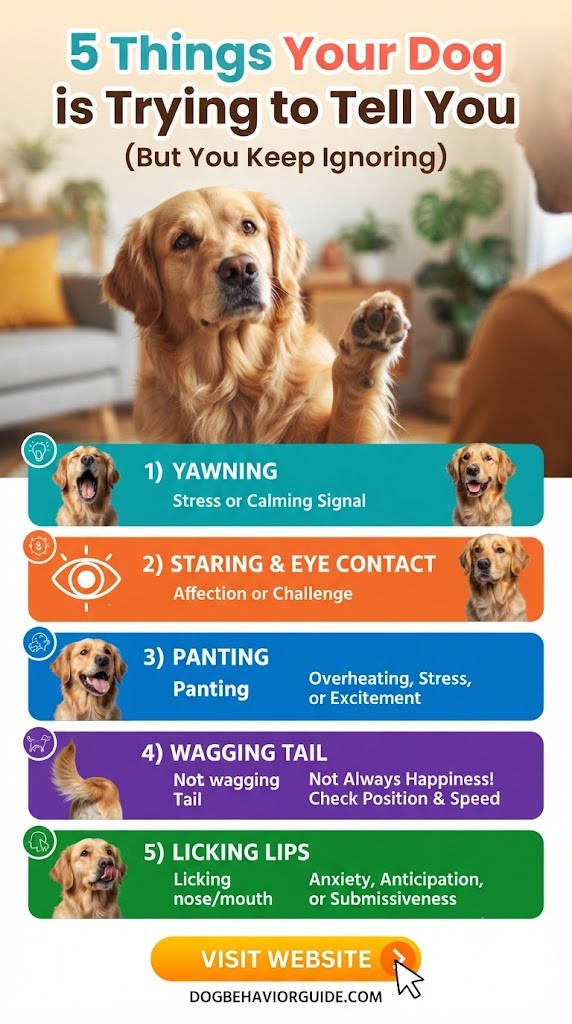

5 Things Your Dog is Trying to Tell You (But You Keep Ignoring)
You love your dog. You provide the best kibble, the softest bed, and an endless supply of squeaky toys. You consider yourself a “dog parent,” and you’re convinced you have a deep, soul-level connection with your furry companion. But what if I told you that every single day, your dog is shouting at you—and you’re completely oblivious?
Dogs don’t have the luxury of spoken language. Instead, they’ve developed an incredibly sophisticated system of non-verbal communication that involves micro-expressions, tail positioning, ear orientation, and even the “scent” of their emotions. While we are busy looking for a “bark” to tell us what they want, we are missing the thousands of subtle physical cues they use to tell us they’re stressed, happy, overwhelmed, or even feeling protective.
If you’ve ever felt like your dog was acting “stubborn,” “disobedient,” or “guilty,” chances are you were actually misreading a very clear message. It’s time to bridge the gap. Here are the five most critical things your dog is trying to tell you—and exactly how you can finally start listening.
1. The Tail is Not Always a “Happy” Signal
This is perhaps the most dangerous and common misconception in the world of dog ownership. We have been conditioned to believe that a wagging tail equals a happy dog. This misunderstanding leads to thousands of preventable bites and stressful encounters every year.
The Nuance of the Wag
A dog’s tail is essentially a barometer for their nervous system. It indicates arousal, not necessarily joy. Arousal can be positive (excitement for a walk) or negative (fear or aggression toward a stranger).
- The Position: If the tail is held high and stiff, vibrating rather than swaying, your dog is in a state of high alert. They are likely assessing a threat. If you ignore this and let a stranger pet them, you are ignoring a “Keep Back” warning.
- The Height: A tail held at a neutral level (aligned with the spine) usually indicates a relaxed state. A tucked tail is a clear sign of fear or submission. However, a tail held extremely high like a flag often signals dominance or intense focus.
- The Directional Bias: Fascinatingly, research has shown that the direction of the wag matters. Because of how the canine brain is wired, dogs tend to wag more to the right when they feel positive emotions (seeing their owner) and more to the left when they encounter something they want to avoid (an unfamiliar, dominant dog).
What You Are Ignoring
When your dog’s tail is wagging stiffly and slowly while a toddler is hugging them, they aren’t “happy about the attention.” They are telling you, “I am incredibly uncomfortable and I am trying to hold it together.” If you don’t intervene, you are forcing your dog to escalate their communication to a growl or a snap.
2. The “Guilty Look” is Actually a Plea for Safety
We’ve all seen the viral videos: a dog standing over a shredded couch or a tipped-over trash can, eyes averted, ears pinned back, looking the picture of “guilt.” Owners often laugh and say, “He knows he did something wrong!”
Science tells a different story.
Fear, Not Guilt
Studies conducted by cognitive scientists, such as Dr. Alexandra Horowitz, have proven that the “guilty look” (technically called the apologetic look) has nothing to do with the dog’s understanding of a past “crime.” Instead, it is a direct response to the owner’s current body language and tone of voice.
The “guilty look” consists of:
- Squinting or blinking eyes.
- Lowered head and body.
- Ears flattened against the skull.
- Averting the gaze.
- Licking the air.
The Communication Gap
When you walk into a room and see a mess, your heart rate spikes, your muscles tense, and your voice takes on a stern edge. Your dog—who is an expert at reading human cortisol levels and facial micro-expressions—immediately senses that you are a potential threat.
In “dog language,” they are displaying appeasement behaviors. They are saying, “I can see you are angry. Please don’t hurt me. I am submissive and I am not a threat to you.” They aren’t thinking about the trash they ate two hours ago; they are reacting to the person standing in front of them right now. By punishing a dog for this “guilty” look, you aren’t teaching them right from wrong; you are simply teaching them that you are unpredictable and scary.
3. The “Whale Eye” and the Stare
In the human world, eye contact is a sign of respect and connection. In the canine world, eye contact is one of the most loaded forms of communication.
The “Whale Eye”
Have you ever seen your dog look at you (or someone else) out of the corners of their eyes, so that the whites (sclera) show in a crescent shape? This is known as “Whale Eye” or “Half-Moon Eye.”
This is a massive red flag that most owners ignore. It is a sign of intense anxiety or guarding. If a dog is chewing on a bone and displays Whale Eye when you walk past, they are telling you, “Stay away, this is mine, and I’m prepared to defend it.” If you ignore this subtle warning and reach for the bone, you are likely to get bitten.
The Hard Stare vs. The Soft Gaze
There is a world of difference between the way your dog looks at you when you’re relaxing on the couch and the way they look at a dog across the street.
- The Soft Gaze: Pupils are normal size, the muscles around the eyes are relaxed, and the dog may blink frequently. This releases oxytocin (the “love hormone”) in both the dog and the human.
- The Hard Stare: The eyes become round, the pupils may dilate, and the dog freezes their entire body. This is a “pre-attack” signal. If your dog freezes and stares at another dog, they aren’t “just curious.” They are locked into a confrontation.
What You Are Ignoring
If your dog is showing the whites of their eyes while being photographed or hugged, they aren’t being “silly.” They are begging for space. By forcing them to stay in that position for a “cute” photo, you are ignoring a direct plea for help.
4. Lip Licking and Yawning (It’s Not What You Think)
If your dog yawns while you’re scolding them, or licks their lips when a stranger reaches down to pet them, they aren’t tired or hungry. These are what behaviorists call “Calming Signals.”
Displacement Behaviors
Dogs use these behaviors to self-soothe and to de-escalate tension in their environment. It is the canine equivalent of a human nervously tapping their pen or adjusting their tie during a job interview.
- The Yawn: A “stress yawn” is usually wider and more intense than a “sleepy yawn.” It’s often accompanied by a little whine or a stretch. The dog is trying to release internal pressure.
- The Lip Lick: This is a quick flick of the tongue that barely touches the nose. It happens in a split second. It is a sign that the dog is feeling uncertain or pressured.
- The “Shake-Off”: Have you noticed your dog shaking their whole body (like they’re wet) after a vet visit or after an intense play session? This is a physical “reset.” They are literally shaking off the excess adrenaline and cortisol from their system.
Why It Matters
When you ignore these signals, you miss the early warning signs of stress. If you’re at a loud party and your dog is constantly licking their lips and yawning, they are telling you, “I can’t handle this environment anymore. Please take me somewhere quiet.” If you keep them there, that stress builds up until it manifests as “unexplained” aggression or a total shutdown (lethargy/depression).
5. The “Paw Lift” and the “Lean”
Dogs use their physical bodies to claim space, ask for reassurance, or indicate hesitation. Two of the most commonly ignored physical cues are the paw lift and the lean.
The Pointing Paw
Unless you have a trained hunting pointer, a dog lifting one front paw while standing still is rarely about “pointing” at something. Instead, it is a sign of conflicted emotions.
The dog is unsure of what to do next. They are “on the fence” about a situation. For example, if they see a new object in the yard, they might stand still with one paw raised. They want to investigate, but they are also afraid. By pushing your dog forward when they have a paw raised, you are forcing them into a situation they aren’t mentally prepared for, which can lead to a fear-based reaction.
The Lean
Many owners believe that when a dog leans their weight against your legs, they are being dominant or “pushy.” In reality, the “Canine Lean” is almost always a sign of affection or a search for security.
- Affection: For many dogs, physical touch is their primary love language. Leaning is their way of being as close to you as possible.
- Anxiety: If a dog leans against you in a crowded area or near a loud noise (like fireworks), they are using you as a “biological shield.” They trust you to protect them, and they are literally leaning on you for support.
What You Are Ignoring
When your dog leans on you during a walk as a large truck passes, and you push them away because you want them to “heel,” you are rejecting their request for safety. You are telling them, “You’re on your own,” which can damage the trust in your relationship and increase their overall anxiety.
The Anthropomorphism Trap: Why We Stop Listening
The biggest obstacle to truly understanding our dogs is our tendency to anthropomorphize—to attribute human emotions and motivations to non-human animals.
We want to believe our dogs feel “guilt,” “spite,” or “revenge.” When a dog pees on the rug after you’ve been gone all day, it’s easy to think, “He’s mad at me for leaving.” But dogs don’t do “spite.” Spite requires a complex understanding of future consequences and past grievances that the canine brain simply isn’t wired for.
In reality, the dog likely peed on the rug because they have Separation Anxiety and their bladder muscles relaxed due to extreme stress. By viewing the act through the lens of “spite,” we respond with anger. By viewing it through the lens of “communication,” we respond with a vet visit or a training plan.
The Cost of Ignoring the Signs
When we ignore these five categories of communication, we create a “Communication Breakdown” that leads to:
- Learned Helplessness: The dog stops trying to communicate because they realize you aren’t listening. They become withdrawn and “shutdown.”
- The “Bite Out of Nowhere”: There is no such thing as a bite that comes out of nowhere. There are only bites where the previous 50 warning signs (lip licks, whale eyes, stiff tails) were ignored.
- Weakened Bond: Trust is the foundation of any relationship. If your dog feels you don’t understand their “No,” they will stop looking to you for guidance.
How to Start “Hearing” Your Dog Today
Becoming a better communicator doesn’t require a degree in animal behavior. It simply requires observation without judgment.
1. The 3-Second Rule
When petting your dog, stop every three seconds. If your dog nudges your hand, leans in, or licks you, they want more. If they look away, lick their lips, or walk away, they’ve had enough. This gives your dog “consent” and agency, which builds massive amounts of trust.
2. Record and Rewatch
If you’re unsure what your dog is trying to tell you, take a video of them in a social situation (like at the dog park or when guests come over). Watch it back in slow motion. You will be shocked at the number of lip licks, ear twitches, and tail shifts you missed in real-time.
3. Respect the “No”
If your dog shows Whale Eye or a stiff body when you try to hug them, stop. Even if you want to show them love, you must respect their communication. By respecting their “No,” you make their “Yes” much more meaningful.
4. Watch the Ears
Ears are like satellite dishes for emotions.
- Forward: Interested, alert, or potentially aggressive.
- Relaxed/Slightly Back: Content and happy.
- Pinned Flat: Fearful or extremely submissive.
- “Airplane Ears” (out to the sides): Often a sign of intense joy or “appeasement” during a greeting.
Common Dog Myths vs. Reality
To help you stop ignoring your dog, let’s debunk a few more communication myths:
| The Behavior | What You Think It Means | What It Actually Means |
|---|---|---|
| Belly Rub Reveal | “I want a belly rub!” | Could be a belly rub, OR a sign of total submission/fear (check for a tucked tail). |
| Bringing a Toy | “Let’s play fetch.” | Sometimes it’s a “gift” to lower tension, or just a way to hold something to feel secure. |
| Mounting/Humping | “I’m the boss/Sexual.” | Usually a sign of over-arousal or extreme stress/excitement. |
| Sniffing the Ground | “I found a good smell.” | Often a “displacement behavior” to avoid eye contact with a scary dog or person. |
Conclusion: The Silent Conversation
Your dog is speaking to you every second of every day. They are telling you when the world is too loud, when they feel safe in your arms, and when they are desperately trying to avoid a conflict.
When you learn to see the flick of a tongue as a request for space, or the shift in a tail’s wag as a warning of tension, your relationship will transform. You will no longer be a person who just “owns” a dog; you will be a person who understands a dog.
Stop looking for the bark. Start looking at the eyes, the tail, and the subtle shifts in posture. Your dog has been waiting years for you to finally join the conversation. Are you ready to listen?