
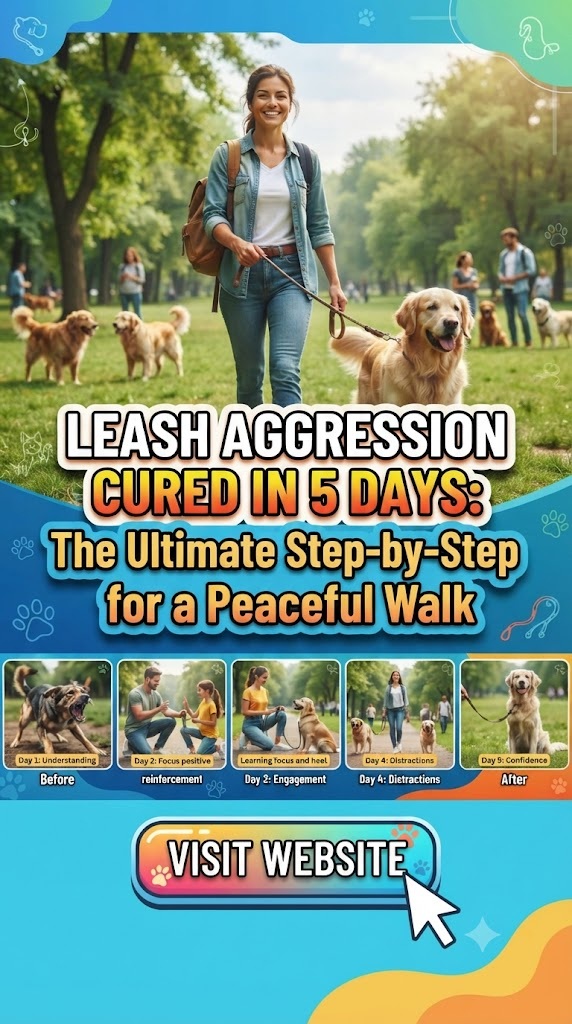

Leash Aggression Cured in 5 Days: The Ultimate Step-by-Step Blueprint for a Peaceful Walk
Walking your dog should be the highlight of your day—a time for bonding, exercise, and fresh air. But for many dog owners, it’s a high-stress nightmare. The moment your dog spots another canine, the transformation begins: lunging, barking, snapping, and a level of intensity that leaves you embarrassed and physically exhausted.
This behavior is known as leash aggression (or leash reactivity), and it is one of the most common challenges dog owners face. Contrary to popular belief, leash aggression isn’t usually about “dominance” or a “mean” dog. It is a complex emotional response rooted in frustration or fear.
The good news? You can see a dramatic transformation in just five days. This isn’t a “magic wand” fix, but a concentrated behavioral recalibration. By following this systematic, step-by-step blueprint, you will learn how to communicate with your dog, manage their triggers, and finally enjoy the peaceful walks you’ve always dreamed of.
Understanding the “Why”: The Science of Leash Reactivity
Before we dive into the 5-day plan, we must understand why your dog is acting out. If you don’t understand the cause, you cannot treat the symptom.
1. The “Fight or Flight” Trap
When a dog is off-leash, they have choices. If they see something scary, they can move away. When they are on a leash, that choice is removed. The leash acts as a tether that prevents “flight.” When a dog feels trapped and a “threat” (another dog) approaches, they default to “fight” as a way to say, “Stay away from me!”
2. Barrier Frustration
Some dogs actually love other dogs, but they get so excited that they become frustrated by the leash’s restriction. This frustration boils over into barking and lunging, which can eventually turn into redirected aggression toward the owner.
3. Leash Tension Feedback Loop
Humans often inadvertently cause leash aggression. When we see another dog, we tighten the leash. This physical tension travels down the line, signaling to the dog: “My human is nervous; there must be something to worry about!”
The Pre-Training Checklist: What You Need Before Day 1
Success requires the right tools. Do not start this 5-day program until you have the following:
- A Front-Clip Harness: This gives you steering control without putting pressure on the dog’s neck. Avoid choke chains or prong collars, as pain often increases aggression.
- A 6-Foot Fixed Leash: No retractable leashes. They offer zero control and teach the dog to pull.
- High-Value “Jackpot” Treats: We’re talking boiled chicken, string cheese, or freeze-dried liver. These must be treats your dog never gets at home.
- A “Treat Pouch”: Accessibility is key. You need to reward within 1.5 seconds of a good behavior.
- A Clicker (Optional): If your dog is clicker-trained, it helps mark the exact second of calm behavior.
Day 1: The Foundation and Trigger Mapping
Today is about observation and setting the stage. You won’t be “fixing” anything yet; you are gathering data and establishing a new communication system.
Morning: Establishing the “Marker”
In a quiet room with no distractions, teach your dog that a specific sound (a click or a sharp “Yes!”) means a treat is coming.
- Make the sound -> Give a treat.
- Repeat 20 times until your dog’s ears perk up at the sound.
- Goal: You want to build a “Pavlovian” response where the sound equalizes a dopamine hit.
Afternoon: Trigger Mapping
Go for a walk in a low-traffic area. Keep a mental (or physical) note of:
- What triggers them? Is it only big dogs? Fast-moving bicycles? Men in hats?
- What is the “Threshold Distance”? This is the most important metric. At what distance does your dog see a trigger but not react? Is it 50 feet? 100 feet?
- The “Yellow Zone”: This is the distance where your dog stares intently but hasn’t started barking yet. This is where the training happens.
Evening: The “Check-In” Game
Inside your house, walk your dog on a leash. Every time they look at you voluntarily, use your marker word and reward. We are teaching the dog that looking at you is more profitable than looking at the environment.
Day 2: Engagement and the “Auto-Watch”
On Day 2, we take the “Check-In” game outdoors, but in a controlled environment (like your driveway or a quiet park).
The “Watch Me” Command
Build a rock-solid focus command.
- Hold a treat to your dog’s nose.
- Bring it up to your eyes.
- When the dog makes eye contact, mark (“Yes!”) and reward.
- Gradually phase out the hand movement so the verbal “Watch Me” results in sustained eye contact.
The “Find It” Game
This is a redirection tactic. If you see a trigger in the distance, toss a handful of treats on the ground and say “Find it!” This forces the dog to put their nose down. A dog cannot easily sniff the ground and lunge at the same time. Sniffing is also naturally calming for a dog’s nervous system.
Building the “Engagement Bubble”
Walk in your driveway. Change directions frequently. Every time the leash goes slack because the dog turned to follow you, reward. By the end of Day 2, your dog should be hyper-focused on you because you’ve become a “Pez dispenser” of high-value rewards.
Day 3: Mastering the Threshold (The “Sweet Spot”)
Day 3 is the most difficult but the most rewarding. We are going to find a place where triggers exist (like the far corner of a park) but stay at a distance where your dog can succeed.
The “Look at That” (LAT) Game
This technique, popularized by trainer Leslie McDevitt, changes the dog’s emotional response to a trigger.
- Spot a dog at a great distance (in your dog’s “Green Zone”).
- The moment your dog looks at the other dog (but before they react), mark (“Yes!”) and reward.
- Your dog will start to think: “I see a dog, and that makes my human give me chicken!”
- Eventually, your dog will see a dog and immediately look at you for their treat. This is an “Auto-Watch.”
Respecting the Threshold
If your dog starts barking, you are too close. Do not scold them. Simply turn around and increase the distance. Scolding a fearful dog only confirms to them that the situation is indeed stressful.
Day 4: Counter-Conditioning and Desensitization
Now that your dog understands that “Triggers = Treats,” we begin to slowly close the gap.
The “In-and-Out” Method
Go to an area where dogs are walked.
- Move toward a trigger until you reach the edge of the “Yellow Zone.”
- Practice three “Look at That” repetitions.
- Turn and walk away before the dog has a chance to explode.
- Why? We are teaching the dog that they can see a trigger and then leave. Movement relieves pressure.
The “Emergency U-Turn”
Sometimes, a dog will turn a corner and be right in your face. You need a “get out of jail free” card.
- Practice a cheerful “Let’s go!” and do a 180-degree turn.
- Reward heavily as your dog follows you away from the “danger.”
- This must be practiced until it is a muscle-memory reflex for both you and the dog.
Day 5: Real-World Application and Management
On the final day, we integrate these skills into your normal walking route, but with a new “Management First” mindset.
The “3-Second Rule”
Do not let your dog stare at another dog for more than three seconds. Staring is the “loading” phase of aggression. After two seconds of looking, interrupt with a “Watch Me” or a “Let’s Go.”
Body Language Fluency
By Day 5, you should be an expert in your dog’s subtle cues. Look for:
- The Tense Tail: A high, vibrating tail is a sign of arousal.
- The “Hard Stare”: Fixed eyes mean a reaction is coming.
- Lip Licking/Yawning: These are signs of stress.
- Action: The moment you see these, create distance immediately.
The “Success Loop”
Complete a full walk. If you encounter a dog, use your “LAT” game. If the other dog is too close, use your “U-Turn.” If your dog stays calm, provide a “Jackpot” (5-10 treats in a row) once the trigger has passed.
The Golden Rules of Leash Aggression Success
To maintain the progress you’ve made in these five days, you must adhere to these lifelong principles:
1. Never Punish the Growl
A growl is a warning. If you punish a dog for growling, they will stop growling—but they will still be upset. You end up with a dog that “bites without warning.” Always treat the underlying emotion, not the sound.
2. Be the “Executive”
Your dog is reactive because they feel they have to handle the “threat” themselves. When you take control of the distance and provide clear directions, the dog feels a sense of relief. They realize, “Oh, my human is handling this; I can just eat my chicken.”
3. Avoid “Halt and Sit”
Many owners try to make their reactive dog sit while another dog passes. This is often a mistake. Sitting makes a dog feel like a “sitting duck.” Movement is a natural stress-reliever. It is almost always better to keep moving in a wide arc around the trigger.
4. Watch Your Own Breath
Humans tend to hold their breath when they see a trigger. This tenses your core and travels down the leash. Practice “box breathing” (inhale for 4, hold for 4, exhale for 4) to stay calm. If you are calm, your dog is significantly more likely to stay under threshold.
Troubleshooting Common Obstacles
“My dog won’t take treats outside!”
If your dog refuses high-value treats like steak or cheese, they are over threshold. They are in a state of “Red Zone” panic. You are too close to the trigger. You must increase the distance until their nervous system settles enough to allow them to eat.
“What if an off-leash dog approaches us?”
This is every reactive dog owner’s nightmare.
- The Treat Bomb: Throw a handful of treats directly at the approaching dog’s face. They will usually stop to eat, giving you time to move away.
- The Body Block: Step in front of your dog and firmly say “NO” or “STAY” to the approaching dog.
- The Umbrella Trick: Carrying a small automatic umbrella can act as a visual barrier. Popping it open between your dog and the intruder can break eye contact and provide a “shield.”
Dietary and Lifestyle Factors in Aggression
Believe it or not, what your dog eats and how they sleep can affect their reactivity.
- Sleep Deprivation: Dogs need 12-14 hours of sleep. A tired dog is a grumpy, reactive dog. Ensure your dog has a quiet place to sleep undisturbed.
- High Protein/Fillers: Some studies suggest that extremely high protein diets or diets filled with artificial colors/preservatives can increase hyperactivity and irritability in certain dogs. Consult with a vet about a balanced diet that supports brain health (Omega-3 fatty acids are particularly helpful for anxiety).
- Decompression Walks: Not every walk should be a training session. Take your dog on “Sniffaris”—long-leash walks in quiet woods where they can just be a dog. This lowers their baseline cortisol (stress hormone) levels.
Beyond the 5 Days: Long-Term Success
You have the foundation, but behavior modification is a journey.
- Consistency is Queen: Don’t let your guard down on Day 6. Every time your dog lunges and “scares” the other dog away, they are being reinforced (they think: “My barking worked! That dog left!”). Consistency prevents the behavior from returning.
- Social Neutrality vs. Social Butterfly: Your goal shouldn’t be to make your dog “friends” with everyone. Your goal is neutrality. A successful dog is one that can see another dog and simply not care.
- Celebrate Small Wins: Did your dog look at a puppy 20 feet away and then look at you for a treat without barking? That’s a massive victory. Celebrate it!
Summary Table: The 5-Day Transformation
| Day | Focus | Primary Goal |
|---|---|---|
| Day 1 | Marking & Mapping | Identify triggers and establish the “Yes!” reward system. |
| Day 2 | Engagement | Build a focus “bubble” where the dog prioritizes you over the environment. |
| Day 3 | Thresholds | Master the “Look at That” game at a safe distance. |
| Day 4 | Proximity | Decrease the distance to triggers while maintaining calm. |
| Day 5 | Integration | Apply skills to real-world routes and master emergency exits. |
Final Thoughts
Leash aggression is not a reflection of your dog’s soul, nor is it a reflection of your ability as a pet parent. It is simply a communication breakdown. By using this 5-day blueprint, you are providing your dog with the vocabulary they need to navigate a world that feels overwhelming.
Patience, high-value rewards, and a deep understanding of thresholds are your greatest tools. Put in the work for five days, stay consistent, and watch as your “reactive” dog becomes the calm, focused companion you always knew they could be.
Happy training, and enjoy your peaceful walks!